दिनर्त्वयनमासांगं प्रणम्य शिरसा शुचिः॥ १॥
paṁcasaṁvatsaramayaṁ yugādhyakṣaṁ prajāpatim,
dinartvayanamāsāṁgaṁ praṇamya śirasā śuciḥ. 1
Translation: We bow with a pure mind and head to Prajāpati, the lord of creatures, the overseer of the five‑year yuga. His very limbs are the day, the seasons, the solstitial course, and the months.
pañca‑saṃvatsaram — the five‑year cycle (the pañcasaṃvatsara yuga used in Vedic calendrics)
ayam — this (person), here
yuga‑adhyakṣam — the overseer, superintendent of the yuga (time‑cycle)
prajā‑patim — Prajāpati, the lord of creatures
dina‑ṛtu‑ayana‑māsa‑aṅgam — whose body consists of day, season, solstitial course (ayana), and month
dina — day
ṛtu — season
ayana — the sun’s course (uttarāyaṇa/dakṣiṇāyana)
māsa — month
aṅgam — limb, constituent
praṇamya — having bowed
śirasā — with the head
śuciḥ — the pure one, with purity
Prajāpati: The Lord of Creatures and the Architect of Cosmic Order
Prajāpati occupies a uniquely fluid yet foundational position in the intellectual landscape of Vedic and Purāṇic thought. He is at once a cosmic architect, a metaphysical principle, a ritual deity, and a symbol of generative potency. Across the Saṃhitās, Brāhmaṇas, Upaniṣads, and later Purāṇas, Prajāpati evolves from a specific deity into a philosophical category representing creation, time, sacrifice, and the unfolding of the universe.
The term Prajāpati literally means “Lord (pati) of creatures (prajā)”. But “creatures” here is not merely biological life; it includes: cosmic beings, the elements, the worlds, time divisions, and even the Vedas themselves. Thus, Prajāpati is not simply a progenitor but the principle of manifestation.
In the Ṛgveda, Prajāpati appears as the first-born of ṛta, the source of all gods, the one without a second, the cosmic desire (kāma) that precedes creation. The famous Nā́sadiya Sūkta (RV 10.129) hints at Prajāpati as the unknown One from whom existence and non-existence emerge.
In the Brāhmaṇas, Prajāpati becomes the central figure of ritual cosmology. He creates the world through tapas (heat, austerity). He becomes time itself—days, nights, months, seasons, ayanas. He is identified with the year (saṃvatsara), the yajña, and the breath (prāṇa). The Śatapatha Brāhmaṇa especially portrays him as the sacrificer who dismembers himself, and the universe arises from his limbs. This is the philosophical root of the verse you translated earlier: “dina-ṛtu-ayana-māsāṅgaṃ…” — time itself is his body.
Prajāpati as Time – The Pañcasaṃvatsara Yuga: In Vedic astronomy, Prajāpati presides over the five-year yuga, the earliest calendrical cycle used for reconciling lunar and solar motions, determining intercalary months and structuring the ritual calendar. He is called Yugādhyakṣa, the overseer of the yuga, including the day (dina), season (ṛtu), ayana (bi-annual cycle) and month (māsa). These are considered his aṅgas, limbs of his cosmic body. Thus, Prajāpati is not merely a deity but the embodiment of time’s architecture.
The Upaniṣads elevate Prajāpati into a metaphysical teacher. In the Chāndogya Upaniṣad Prajāpati instructs Indra and Virocana on the nature of the Self (Ātman). Here he is the knower of immortality, the guardian of the subtle truth, and the one who tests aspirants. In the Bṛhadāraṇyaka Upaniṣad he becomes the cosmic mind, the first person, and the source of speech, breath, and the senses. In these texts, Prajāpati is no longer a mythic progenitor but a symbol of consciousness and the inner Self.
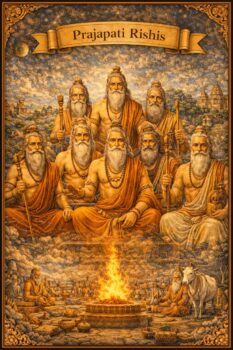
In the Purāṇas, Prajāpati becomes a category of beings rather than a single deity. There are ten Prajāpatis who rule the ten directions of the manas. Sometimes twenty-one, and sometimes thirty-three, depending on the text. They are the mind-born sons of Brahmā, responsible for populating the universe. Prominent Prajāpatis include Marīci (replaced by Kaśyapa), Atri, Kratu, Pulastya, Angiras, Pulaha, Vasiṣṭha and also Bhrigu, Dakṣa, Narada.
A profound Vedic idea is that Prajāpati is Yajña, and yajña manifests as the Lagna in vedic astrology. Thus, Prajāpati manifests the Lagna of every jiva. The universe is created through sacrifice; The sacrificer becomes Prajāpati; The altar (vedi) is his body; The fire is his mouth; The oblation is his breath. This identity between cosmic creation and ritual action is one of the most sophisticated contributions of Vedic thought.