
मेषाजः विश्वकृयतुम्बुराद्या वृषाभगाताबुरुगोकुलानि ।
द्वन्द्वं नृयुग्मां जितुमं यमं च युगं तृतीयं मिथुनं वदन्ति ॥ ४॥
meṣājaḥ viśvakṛyatumburādyā vṛṣābhagātāburugokulāni |
dvandvaṃ nṛyugmāṃ jitumaṃ yamaṃ ca yugaṃ tṛtīyaṃ mithunaṃ vadanti || 4 ||
From Aries arise the groups of deities such as Viśvakṛtya, Tumburu and others;
From Taurus come the groups called Bhaga, tāburu and gokula.
The third sign, Gemini, is described as dual in nature, a pair of humans,
connected with Yama, and endowed with the quality of conquest.
meṣa: Ar🐏
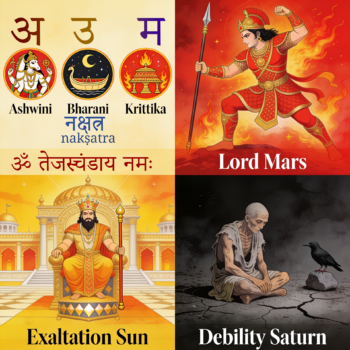 Viśvakṛta (विश्वकृत)
viśva = world, universe; kṛta = made, done
Viśvakṛta = “world‑made” / “made for the world” / “made by the world‑maker.”
(a) Made by Viśvakarman is one interpretation and refers to all objects created by the divine craftsman Viśvakarman. This includes the idol of Jagannāth in Puri, Odisha.
(b) Creator / creative agent: in Purāṇic and astronomical literature the root sense extends to denote the creator of the universe. This is applied to Brahmā or to the supreme maker, to prajāpati the creator of all jīva, to Dhātā Āditya and counterpart Vidhātā; Viśvakṛt as “the creative agent” in Bṛhat-saṁhitā and Purāṇic passages.
तुम्बुरु Tuṃburu
A celebrated gandharva musician Tuṃburu, famed as the foremost celestial singer and leader of the gandharvas in Hindu dharma. As a word it is a proper noun, not a translatable adjective; in context it is usually left untranslated and explained as “Tumburu the gandharva” or “Tumburu the celestial musician.
vṛṣa: Ta🐂
भग bhaga
masculine noun meaning “share, portion, lot, fortune, prosperity, blessing” and also the name of a Vedic deity associated with wealth and good fortune.
root भज‑ (bhaj‑) “to share, distribute, partake”; bhaga originally denotes a portion or share that one receives.
Bhāgya (भाग्य) “fortune, destiny”; Bhagavān (भगवान) “one possessing bhaga — the fortunate or venerable one”; bhāga (भाग) alternate form meaning “part, portion”.
Bhaga is a Vedic god who grants wealth, cattle, and good fortune; hymns in the Ṛgveda invoke Bhaga for prosperity.
भगः सर्वेषां समृद्धिः। bhagaḥ sarveṣāṃ samṛddhiḥ – Bhaga is the prosperity of all.
तस्य भाग्यं उत्तमम्। tasya bhāgyaṃ uttamam – His fortune is excellent
गोकुल gokula
means cow‑pen or herd of cows and also names the pastoral village where Kṛṣṇa was raised; it’s usually left untranslated as a proper name or rendered Gokula (the cow‑village); herd of kine; cow‑house, cow‑station; a village or tract (on the Yamunā)
go‑ (गो) = cow; ‑kula (कुल) = group, family, enclosure. Thus gokula literally denotes a group/enclosure of cows (a cow‑pen or herd). Hidden meaning can be a kula (कुल) from go(गो) or gotra (गोत्र)
In Purāṇic and epic literature Gokula is the name of the pastoral settlement on the Yamunā where Nanda and Yashodā raised Kṛṣṇa; in that sense it functions as a proper name and is usually translated as “Gokula (Krishna’s cow‑village)” rather than literally “cow‑pen.”
गोकुले कृष्णः बाल्यं यापयत्। gokule kṛṣṇaḥ bālyaṃ yāpayat – In Gokula, Kṛṣṇa spent his childhood or Kṛṣṇa spent his childhood in Gokula (the cow‑village)
mithuna: Ge🧑🤝🧑
जितुम् jituma
accusative singular form used when the word is the direct object in a sentence meaning “Gemini” (the Twins, the third sign of the zodiac)
it is a modern (post Mihira) word Sanskrit adaptation of the Greek δίδυμοι (the Twins), adopted into Indian astrological/astronomical vocabulary for the zodiac sign. It appears in classical astrological works such as Bṛhajjātaka and Laghujātaka; not Vedic.
यमं yama
Yama (यम) is primarily the Vedic and Purāṇic deity who rules death and the afterlife; the same root also gives the abstract noun yama meaning restraint or moral control in yoga literature.
Vedic devata who presides over the departed, justice, and the south kendra; in later literature he is called Yamarāja or dharmarāja (king of law). He governs nyasa (Mars). Yamaḥ pitṛ‑rājā — Yama, king of the ancestors.
Root: He is the gatherer or one who restrains/controls. Ṛgveda Yama is described as the first of mortals and the early ruler of the departed; he is associated with guiding souls to the ancestral realm. In Purāṇic and Smṛti literature Yama becomes the judge of the dead who, with attendants and recorders (e.g., Citra‑gupta), examines a soul’s deeds and assigns its post‑mortem fate; he is often equated with Dharma in his judicial aspect. Yama is commonly depicted as grim, sometimes green or red in color, riding a buffalo, holding a noose or club, and accompanied by two dogs that guard the path of the dead.
Yama as moral restraints: Separately, yama (same spelling) denotes the set of ethical “don’ts” in classical yoga system (non‑violence, truthfulness, non‑stealing, continence, non‑covetousness). This is a different lexical sense derived from the idea of restraint or control rather than the deity and is also applicable to Mithuna Rāśi making them good in Haṭha Yoga
Every word must be studied carefully and noted in the slokas for the signs.
You must be logged in to post a comment.